Reflecting on Five Years of Running

The last several years on January 27, I get a text message or Facebook message from my friend, Brad: Happy Running Anniversary!

Brad is not a runner, at least not anymore. He was, for a short time, to raise money for charity. The desire to be charitable with his time took root; a love of running did not. So Brad now uses other methods to do good work for charity: water and the Detroit chapter of Engineers Without Borders (both are excellent causes: I link to them both so you can check them out). But Brad, being the kind of guy that he is (and assisted by his external brain, Google Calendar) knows running is a defining part of my life and so last Wednesday I woke up to the message: “Happy Running Anniversary! How many years has it been?”

Five. Wait, what, five? Five years?!

Yes, it has indeed been five years since I took my first wonderful (read: pain-inducing) steps as a runner. I like anniversaries and milestones. I like having those definitive moments where one can stop, take stock of life, and measure the progress that has been made from Point A to Point B. A five year anniversary seems as good as any time to do that and so during some quiet moments at work I took the time to reflect on what running has given me in the last five years.

1. New Places to See That Have Stretched Me As a Runner

I like to explore. Around home I like to find unbeaten paths I haven’t walked and out of the way dives I haven’t yet poked around in. The moment I began running it was clear I needed to find new trails to run as gamboling down the same country roads every day was simply not going to keep me engaged.

Luckily the Cleveland area puts a premium on preserving nature through its Metroparks System and the Cuyahoga Valley National Parkway. In five years I have become familiar with both. Anyone who has run through the woods knows it is a calming experience. Some of my favorite runs have come when leaves are starting to bud on the trees in the stretch of the Cuyahoga Valley that sits tucked amongst the steel mills in the southern part of Cleveland, during sunset in the middle of summer in Valley View, or when red and orange and yellow leaves are falling on paths near Boston Mills Ski resort. The terrain, though largely flat, offers enough twists, turns, and hills that afford me the opportunity to mix up my long runs, introduce hill repeats to break up my tempo runs, or even allow me to run challenging multi-mile up and down hill runs that help me build speed and power. It’s an experience unique to Northeast Ohio and I am richer for finding these trails.

2. The Benefits of Structure

With running you get out what you put in. When I started running I had no idea what I was doing. I ran as far as I could. If it felt like I should run fast, I did. Stretching? Sure, why not? And of course since I was now exercising far more than I had before, I was totally ok to eat those two eclairs, right?

If running had just been an activity I used to pass the time, that would have been ok, but early on I knew I wanted to run and to race to excel. I knew I would never run a 4-minute mile, but I could run a half marathon in under 90 minutes, I could approach a 3-hour marathon, I could qualify for Boston. Doing that though was going to take long term thinking and strategic planning.

Over five years I have come to understand how important structure is to a runner. With each year I find a detail I have previously overlooked that turns into an important wrinkle in my training. As I have become more obsessive (and I use that word in a positive sense here) about my training, my times have likewise dropped, starting with that first half marathon I ran in 2011 in 1:39:48 to last October’s 1:26:48. Below are some of the ways structures that have benefitted my running:

  1. I find a plan equal to my experience and follow it religiously. The experience level is key. If you are beginner running an advanced plan will only result in injury. Following a plan religiously is how you build a foundation for future adaptations. First you have to show you can follow a plan closely and be successful with it and the volume of running it is asking you to do. Then you can begin to make changes that will result in faster running.
  2. I make small changes incrementally. Once I know I can handle a given plan I begin to add small changes that should make me faster. Making small changes is key, especially early on. Not only do you want to build on your foundation, but you want to see what changes benefit you the most. I have found, through three years of trial and error, that I respond best to interval runs. Even my tempo runs now are broken up with hill intervals, which breaks up the tedium of long tempo runs and provides more bang for my training buck. I only found this out though because I first introduced tempo runs, then eventually interval runs, then finally hill repeats into my training over three years, saw how my body responded, and made changes where I felt they were needed.
  3. I added dynamic flexibility to my warm up. This was a major change after I spent most of 2013 sidelined from running with IT band issues. Previously I had warmed up with the same static stretching routines I had done since high school track. The result was a body that was not ready for running and injuries soon followed. Running for miles on end requires a proper warm up that doesn’t just stretch the muscles but elevates the heart rate and gets your body moving in a way that will mimic running. Dynamic warm ups do this. I will be providing my dynamic warm up in a new post soon.
  4. I continue to become more obsessive over the details that can affect my running health and performance. I have begun this year to strength train several times a week, focusing on my core, hips, and glutes. I am currently battling a forefoot injury and I recognize, more than ever, that foam rolling and flexibility, before and after running, is critical. The goal over the next few years is to qualify for Boston and with that lofty goal will come continued scrutiny over how I can tweak any element of my life to give me a running edge.

3. It Has Helped Me Learn How to Handle Failure

I spent my 20’s wanting to be somewhere else. Anyway else. I was supposed to be in this graduate program, have that job, be married by now and have this many kids. I valued the end result and paid little attention to enjoying the process. Ironically, I started running because I thought it would be something I could control and move forward while other aspects of my life stood still. In time, I would see what a misguided approach to running this would be and eventually I would be richer for it.

It is true that you get out of running what you put in and it is equally true that the road to running success is anything but smooth. Injuries will happen. Runs will go dreadfully wrong. Races you have spent months planning and training for will be sabotaged by weather or cramps or sickness or a poor race strategy. As it is in running, so it is in life.

When I was new to running the smallest nagging pain, the tiniest setback on a run would infuriate me. I thought, not about the problem, but about what the problem could cost me. I cannot point to any one moment where this changed. Maybe I mellowed out after 2013, where IT Band Syndrome robbed me of almost an entire year of running. When  you lose a whole year of running, how much worse can it really get? Maybe it was watching Meb win Boston in 2014. Here was a runner whose career was almost ended by a hip injury back, thriving, and winning that oh so emotional Boston Marathon. If a professional whose entire life is dedicated to the science of running at peak level could almost lose his career to setbacks, it was crazy for me to let my own setbacks ruin my attitude. Whatever the penultimate jolt was, I began to shift my focus to a longer view.

The change in attitude required a subtle but powerful shift. Rather than letting my frustration controlled me, I had to use that energy in a new way. I developed the following approach:

  1. I did not suppress my frustration, but I did not give in to it either. Instead I observed it and took the energy that came with it and refocused it.
  2. I put my energy into understanding whatever setback I was encountering. If I was hurt, I looked back to figure out why. Had I ignored pain? Was I neglecting my strength program? If I had a bad run, I looked at what might have caused it. Had I eaten well the past few days? Was I hydrating properly? Had I gotten enough sleep?
  3. I created a plan to keep this setback from happening again. If I was hurt, I focused on fixing the injury and then adding prehab routines into my training. If my long run had gone bad, I fixed the root cause.
  4. I stayed focused on the process rather than wringing my hands over a race result that was months away. No longer did I pay attention to what I was losing with that bad run or a few weeks lost to injury. Racing success comes from a cumulative build up of a long bout of training. If it is done consistently, more often than not the results will be positive.

As I made this shift with running, so too did I make it with life. I am far more calm now as a soccer coach. Setbacks are no longer horrible obstacles that prevented my team from reaching its potential but rather teachable moments that might help them see how they can scale the mountain. When work is not going well I take a step back, remember that I have learned much in my job, and seek out help if necessary to tackle the obstacle. I have come to love the process, to appreciate all the little work that goes into success, any success. Because success will come, just not always when I want it to.

4. The Sweet Sweet Feeling That Comes With Earning a Race PR

I knew, after four years of running, that I was going to break 1:30:00 in a half marathon at Mile 12 of the Towpath Half Marathon in October 2014. I had had an inkling since early in the race that this would be the day. My splits along the course were phenomenal, at times a minute ahead of where I wanted to be, and my effort was smooth and easy. At Mile 12, with my watch showing me a sub-1:22:00 time, I finally let myself believe it. This would be the culmination of four years of effort of fixating on this time.

When I had first decided that 1:30:00 would be my mark, shortly after I crossed the finish line of my first half marathon in a 1:39:48, I underestimated what I would need to do to reach my goal. I was new to running; I didn’t know what I didn’t know. For four years I would be disappointed over failures, struggle through workouts I wasn’t ready for, ice my way through injuries, cursing that I felt so far away from breaking that challenging time. It would take me time to realize that these setbacks were making me a smarter, faster runner.

All of which culminated in the deepest level of satisfaction I can recall the minute I crossed the finish line at the end of that race in October 2014. It’s a satisfaction I think anyone gets after a particularly good race, where a runner can look back at the months of work that went into making such a memorable achievement, the growth, the battles back from a bad run or an injury. The road to that finish line is rarely smooth but once you cross it the bumps don’t seem to matter anymore.

I smiled for a week after that race. It was as if I was enjoying a week-long runner’s high that my body did not seem to want to let go. Then four years of focus on that elusive time turned to a new road ahead. I had vowed I would not tackle a marathon until I beat 1:30:00. Now I had and it was time to decide when and where I would attempt this new race. While 1:30:00 was a nice time to focus on, having beat it, I wondered how much faster I could get in the half marathon. So I enjoyed my post-race week, basked in the glow that only can accompany an excellent race, and then it was time to move on, to ask: What’s next?
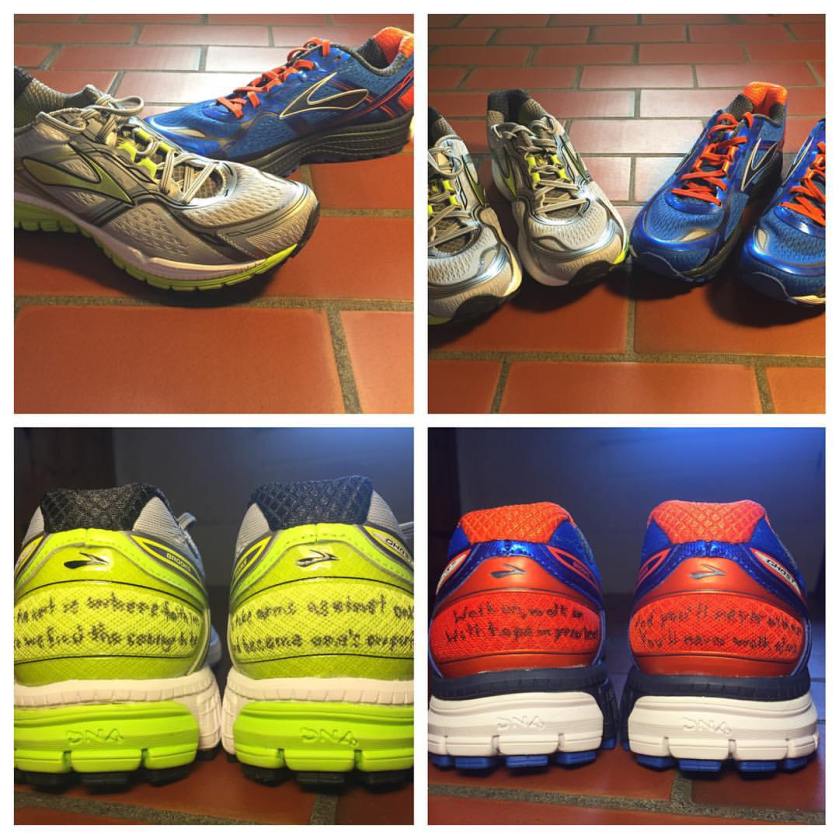
 

New year, first marathon, new shoes to get me to the finish line

Brooks has been my go-to shoe since a helpful clerk at Second Sole in Rocky River, Ohio (pay them a visit, they know their stuff and have never been anything but helpful) first gave me a pair of Brooks Ravennas to try on. If you have ever watched Harry Potter and the Sorcerer’s Stone (nerd alert) and you can remember the scene where Harry chooses his wand (winds rush, he feels an electricity in fingers), well, that is what it was like when I tried on my first pair of Brooks running shoes. I have since graduated to Ghosts; I now wear Brooks Ghost 8’s. When I lace up, it feels like I am wearing a pillow on my feet.

To both shoes I added a motivational quote. They are hard to read because the mesh on the back of the shoe is not the easiest of canvases to write on.

On the Gray/Green, a quote from George Sheehan: The heart is where faith lies. Where we find the courage…to be. To take arms against oneself and become one’s own perfection.

On the Blue/Red: Walk on, walk on, with hope in your heart. And you’ll never walk alone. You’ll never walk alone.

#RunHappy #BrooksRunning

12465875_10100225746579503_6929748460899614188_o

The Good, The Bad, and The Ugly of 2015

Since I did not launch this blog until January 1st, there was no obligatory end of year post for 2015 in which I broke down the ups and downs of the past year. And yet 2015 was an important year for me as a runner, as instructive as any year I have had since I first laced up in 2011. So without further ado, I give you the good, the bad, and the ugly of my 2015 (in reverse order so I can end on a high note).

The Ugly

Trying new things without considering where they fit into my training

I experimented a great deal in 2015, adding new elements to old workouts such as making the standard long run a progression run or mixing hill repeats into my tempo runs. Often these changes were calculated well in advance and added to my training programs in appropriate places. Occasionally, in my zeal to try something new, I would read about a new workout and spontaneously try it the next day.

Bad idea.

One such ran was a modified progression run. I like progression runs. I tend to make every third long run a progression run in which the first half is run at a comfortable pace and then run the second half with some sort of speed element. This mimics my racing strategy in which I try to run negative splits. For four years I have trained this way. The new progression run I read about began mixing in speed play right from the start after a two mile warm up. This was far more intense and much earlier than any sort of long run I ever attempted. The result was me, four miles from my car, utterly spent. It was a hard lesson learned. As you progress as a runner you absolutely should attempt more challenging variations of your tried and true hard runs. But plan these runs well in advance and consider how your training earlier in your cycle will build, not just to your race, but to these more challenging runs. Or endure a four mile shuffle of shame back to you car.

Running when I could not control my emotions

Somewhere in the near future I will be committing time to writing a post on how running helped me tame and understand depression. Now is not that time. For now, accept that in March of 2015 I began to recognize that I was depressed and that for the next five months or so I would run while trying to understand my depression’s underlying causes, which were related to my career. Running would end up playing a critical role in my ability to tame the beast, but before it did, the beast wreaked havoc on my running.

We all run amidst distractions and stress. We have families, we have jobs, we have student loans and bills; we are pulled in 20 directions at once. Since I started running it has been a respite from the normal stress of everyday life; it is often where I feel most like myself. None of this was true last spring.

In hindsight it may have been wise to stop training for my spring half marathon and simply enjoy the therapy that running afforded me. However, I have always run to race so that option never crossed my mind. What did cross my mind, at least early in my depression, were the constant thoughts of inadequacy, of frustration, and of worthlessness. I had left a job that I deeply loved, yet also needed to leave. It was the right decision but after the relief of making it wore off, guilt crept in. When I ran my negative thoughts were my constant companions. I ran angry, so angry in fact that I had a headache for two days after I PRed a five mile race because I ran the entire race with my jaw clamped down tight in anger.

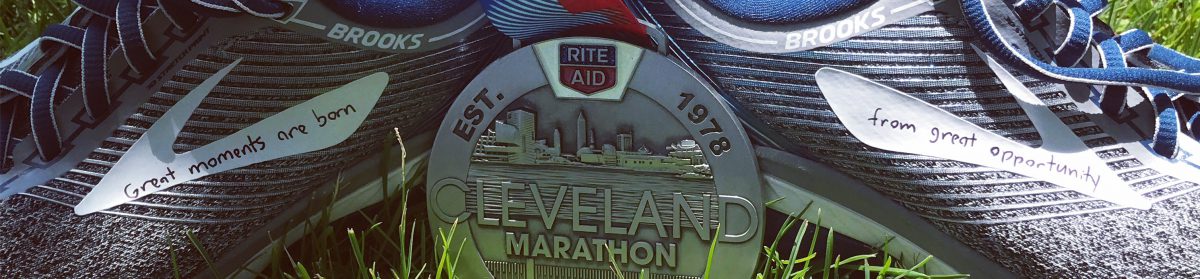
It all came to a head in May at the Rite Aid Cleveland Half Marathon. By this point I was teetering close to serious injury, I had attacked my runs with such ferocity. I always plan my races carefully, intending to start slow, mapping out where I will get water, choosing points where I will make the decision to push the pace further or back off. I planned as I always do, then on race day I threw it all out the window. I blew through my usual early race pace and settled into a punishing one that, if I could hold it, would trim four minutes (Adam, you idiot) off my PR. I drank little (why slow myself down), I downed an energy gel far too early (and away from any water to help wash it down – hello cramps!), and I did what I had done for the last two months: I ignored every alarm bell, every warning sign my body kept throwing at me (you know this won’t end well, right?). So I crashed. Hard. The last three miles were an agonizing shuffle uphill in quickly escalating heat. Amazingly I finished only four seconds off my time from 2014, four seconds off of my course record. But whereas I had felt fresh and energized the year before, I crossed the line in 2015 beaten and broken. It would take me three weeks to recover and longer to enjoy running again.

The Bad

Not sticking to a strength plan:

As frustrating as the start to 2015 was, I made several strides that set me up for this year, where I will be tackling my first marathon. An area where I felt short of preparing myself for 2016 was in sticking to a consistent strength plan. I blame two factors. First, I did not pair the right workouts with the right running days. I would attempt punishing strength workouts right after I had completed punishing runs, leaving me exhausted. Not the ideal way to build a constructive habit. Second, I failed to create the conditions that would help me start and then maintain the habit of completing strength workouts on a daily basis. Habits and habit formation for runners is a topic I will be covering soon, so I will not be spending much time talking about it here. For the time being it is enough to know that beginning a new habit, completing daily strength training, required me to consciously create conditions that would make such training an automatic part of my regimen. I failed to give this the proper attention early and as a result I failed to meet this goal.

The Good

Despite the hangups, the ugliness of letting depression interfere with my running and failing to build habits that would make me a stronger runner, 2015 was a good year. I was able to use the failures mentioned above to become a smarter runner and I continued to build on the success I have had since I took up running in 2011. This led to some memorable moments.

40+ mile weeks

I said 2015 was a transition year for me and the most successful transition I made was to add mileage to my weekly training in preparation for 2016’s marathon training. As I prepared for my fall half marathon I created a training program that added roughly ten more miles a week to the low to mid-30’s I had averaged near the end of 2014. Best of all, I adapted my training schedule (more on this below) to ensure that the added mileage did not lead to injury. The result was my fastest half marathon yet (by 2:20 off my 2014 PR) and the confidence of knowing that I have tackled most of what my first marathon training plan will throw at me.

The long run in Manteo

Sometimes the best runs are the ones that have nothing to do with training. You leave the watch at home, you walk out the door and simply run.

I vacation in the Outer Banks yearly with my family. It is a spiritual place for us; we have gone there to heal after several difficult times. There we can simply be. Last June I was starting to feel that I was crawling out of the hole I had been in since early March. I had confronted the most of the issues that had left me feeling inadequate, angry, and worthless. I was beginning to make peace with where I was in life. It was on a long run on tiny Roanoke Island that I felt like I turned a corner.

Training that week had not gone well. Unseasonably hot weather (the heat index hit 120 several times) made running uncomfortable and exhausting. Yet one hot afternoon I felt the need to run. While my family fished I made my way to Manteo, a small town on Roanoke Island, Norman Rockwell on the Water my mom calls it, and took off. Despite the heat, I ran, no longer feeling the anger I had in the previous months, just enjoying the salt air and the quaint scenery of the small houses, the island farms, woods, the site of the Lost Colony of the 1600’s where the first English child, Virginia Dare, was born, and then finally the island’s end where a small beach sits beside a bridge that takes you to the mainland.

I did not plan it, yet at the waterside I felt a weight melt away. I no longer felt worthless. I no longer felt like I wasn’t where I was supposed to be in life. Overcoming depression is never that simple. I still had much to work out. But for the first time in four months I felt some semblance of normalcy and hope. I felt like me again. I watched the waves for a few more minutes and then I turned back, concluding the second half of one of the more meaningful runs I have ever had.

Nine-day training blocks

After Meb Keflezighi won the Bosotn Marathon in 2014 there were calls to know just how he had done it. Meb was at an age where runners are supposed to be slowing down, not speeding up. Yet Meb had defied the odds and captured that most poignant of Boston Marathons a year after the 2013 bombings. Meb revealed some of his training secrets in his book, Meb for Mortals. For serious racers it is a must-read. In the book Meb shares one particular training secret that I instantly adopted: 9-day training blocks. The blocks replace the weekly schedule that is the hallmark of almost every training plan you will ever see. In his book, Meb explains that changing to the 9-day blocks became necessary as he got older and could no longer take the pounding of weekly training.

This was exactly how I felt. Too often when I ran my three key workouts in a week I felt fatigued, or I would have to skip key workouts because of soreness, or I would run the workout but badly miss my planned time. My training often featured a week-long break midway through so I could avoid serious injury and/or recharge my batteries. Following Meb’s example I re-wrote my fall training plan to fit into 9 day blocks. I still ran all the key workouts that were called for in the 12 week plan I had adopted. I simply extended the length of training to be 12 x 9 days instead of 12 x 7. To make sure I maintained the higher weekly mileage I wanted, I added in easy days every week, anything from 3-6 miles to ensure I met my mileage goals. The result was the best, healthiest training I have ever done. Even in the summer heat, I often hit my time goals, I felt stronger during my long runs, and I often had to hold back to make sure I did not overdo during my easy runs. I firmly believe this change is why I stepped up to the start line of my fall half marathon feeling as good as I ever had.

My PR at the Towpath Half Marathon in October

The rocky start to 2015 had long-since smoothed out when I laced up and toed the start line of the Towpath Half Marathon in October. Depression had been tamed, new training had been successfully completed, higher training volume had been conquered. I was strong as I had ever felt as a runner and the result, a PR by 2:20, would bear that out.

Though I will not give a whole race report, one part of that race stands out. I love the Towpath Trilogy races because, as small races set in a national park, they are a direct contrast to the bigger, crowded races I run in cities. I love both types of races, I simply enjoy ending my year with something more secluded, scenic and personal. The race course for the Towpath Half Marathon is essentially an out-and-back course and as I hit the turnaround to take me back toward home I found myself completely and utterly alone. I could hear no one behind me and the closest runner ahead of me had a solid lead of 100-150 yards.

I had, up to this point, been running slightly ahead of the pace I wanted to run and I began to wonder if I could maintain it. I wasn’t worried about dropping into the dreaded shuffle but I felt that maybe I had overextended myself and needed to slow it down and accept finishing with a time similar to my 2014 race. Yet, I kept seeing that runner ahead of me. I made my decision and decided, slowly, to track him down. I was at Mile 7. I would not catch up to him for three miles. When I did, I toyed with the idea of passing him, but I had expended so much energy just to catch him and his pace was still strong, still just ahead of what I thought I should run that I just settled in behind him. For the next two and a half miles we ran together. I always have a kick and my kick occurred a half mile out from the end. I began my sprint, passing this runner who had probably kept me going for the last 5.5 miles and then passing others in a pack just ahead of him. I crossed just ahead of a pack of ten or so runners, including my racing buddy from those last six miles. It was enough to get me third in my age group and to trim off that 2:20 from me previous year’s time.

There is an African proverb: If you want to run fast, go alone. If you want to run far, go together. For the last half of that race we two runners had gone together and that, as much as anything I learned, experienced, or conquered in 2015, helped me complete that wonderful race and draw my my running in 2015 to a close.


Here at the start

“It’s a dangerous business, Frodo, going out your door. You step onto the road, and if you don’t keep your feet, there’s no knowing where you might be swept off to.”

-Bilbo Baggins

The first training run I ever completed for a race was on a treadmill. It was a late January day almost five years ago. I struggled to finish one and a half miles. Then I died. Lungs burning, mouth parched, I had just accomplished some sort of record feat that would go down in the annals of running. Only that could explain the soreness from that little jog that would last for days. I was doomed. If I was swept away that day, it was to a couch. What the hell had I gotten myself into?

I love journeys, have all my life. Where Bilbo Baggins sees danger (though I suspect only with less terror than he lets on), I am intrigued the possibilities of the archetypal journey, the promise of growth and change amidst unpredictable circumstances. I have come to love running because on any given day, a journey can and does occur. Obstacles are encountered. Sometimes they are defeated, sometimes they are not and one stalls, trying to find a new way to overcome the challenge. But always, one moves forward, one step at a time, sometimes striding lightly without effort, sometimes almost crawling, step-by-step over the mountain. But always forward.

Forward is the direction I moved after that January run, eventually. I trained sporadically, with little structure, doing so only because a girl had asked me to. But I trained. Always forward. And then, on race day, something magical happened, a life-changing euphoria washed over me as I crossed my first finish line, the end of my first running journey. I fell in love with running. I sat amongst throngs of enthusiastic supporters, helpful volunteers, and exhausted but smiling runners and I fell head over heels in love with running. From that day forward I would not, I could not, look back to a day when I was not a runner.

Almost five years have elapsed now and my running journey has gone uphill and down. I have set PR’s and missed almost an entire year to injury. I have shared my love of running with others and even convinced one or two to race. I have seen the habits I have developed from running trickle into other, unrelated parts of my life. And when things have truly gotten dark at times in my life, my running goals have maintained a small but determined fire that has kept me moving forward.

My goal here is simple: to help my readers become better runners by sharing my insights, my stories, and my stumbles. I am an average guy who has learned how to run because others have shared their experiences as I now will. My racing, my fitness, my nutrition, and my enjoyment of the sport have all been enhanced because running is a community, one blessed with many who are willing and eager to take the time to share what works and, perhaps with even more courage, share what doesn’t. This space will be a small addition to their work.

And so I welcome you to my little rest stop on life’s great marathon course. Hopefully I have a little to teach you about running, and I look forward to you sharing your experiences with me as well. Until then I’m back out my door to see where running may sweep me off to.

Remember, forward, always forward.


Adam