Ten Books Runners Should Read In 2019

Okay, so this was supposed to be a year-end post in 2018 where I reviewed the top books for runners I read last year. However, when your brother decides to push up his wedding and it requires a multi-day drive to arrive at the destination, things get pushed back. So here I sit, posting this a week later than intended but still chock full of information I hope you will all find useful. The ten books I am going to list are not all running books per se, but they are all books that can benefit or be of interest to runners.

Peak Performance: Elevate Your Game, Avoid Burnout, and Thrive with the New Science of Success by Brad Stulberg and Steve Magness

By far the best book I read in 2018. It is full of information on performance, recovery, establishing a proper mindset, and more and is applicable to running and life. I reworked almost all aspects of my training program to incorporate their suggestions. Stulberg is a former consultant at the elite McKinsey and Company and now coaches and writes about human performance. Magness is a coach to professional runners and the cross country coach at the University of Houston. Their twitter feeds are a plethora of great information and I highly recommend you follow them. Stulberg is @BStulberg and Magness is @stevemagness.

Atomic Habits: An Easy & Proven Way to Build Good Habits & Break Bad Ones by James Clear

The Power of Habit by Charles Duhigg is one of the more important books I’ve read in the last five years. I still listen to the chapter on keystone habits five or six times a year. Duhigg covers the theory and science of habits and habit formation well and Clear builds on it with practical approaches to creating new habits, breaking bad ones, and advice on how to streamline the process. Anyone looking to start a new running routine or review their current running routines would be smart to give this book a read.

You Are Not a Rock: A Step-by-Step Guide to Better Mental Health (for Humans) by Mark Freeman

A mental health book may sound like a strange suggestion to runners but I think this book is a must-read tome for anyone. Freeman shares his own struggles with mental health (tales which showed me that I was not nearly as alone as I thought in my own struggles) and details an ongoing process people can utilize to handle their own mental health issues. One early strategy Freeman highlights is learning to identify and sit with your compulsions, rather than feeling the need to give in to them. His writing on compulsions made me realize how often I give in to compulsions, (cough checking my phone cough) even in the middle of workouts or between running and strength sessions. These habits have surely robbed me of some of the gains my workouts are designed to elicit and I have since begun to work on identifying my own compulsions and working to overcome them.

Endure: Mind, Body, and the Curiously Elastic Limits of Human Performance by Alex Hutchinson

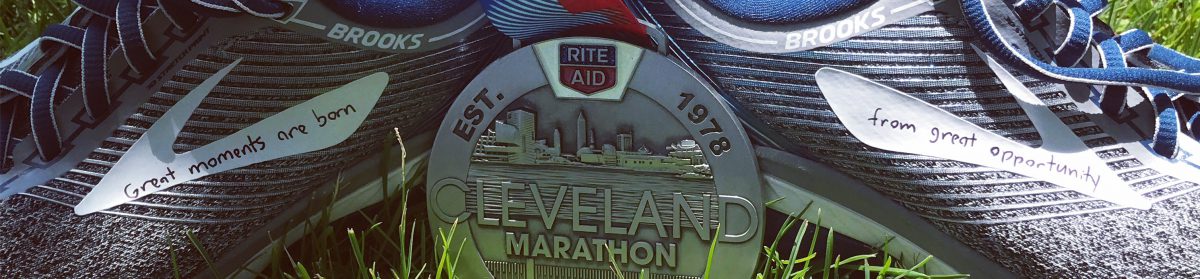
I read this early last year and was captivated by the different stories Hutchinson (one of my favorite sports science writers) shares. He dives deep to help us understand the roles the physical and psychological play in our ability to push ourselves to and even beyond our perceived breaking points. I took my mantra for last year’s Cleveland Marathon, “pain is a privilege” directly from reading this book.

Running Rewired: Reinvent Your Run for Stability, Strength, and Speed by Jay Dicharry

Dicharry is a physical therapist and running coach whose approach to strength training is to make sure runners are running with the proper muscles firing before they take on trying to lift heavy loads. Dicharry’s book clearly details the various ways that muscle imbalances and lack of mobility can compromise a runner and result in injury. A series of tests and corrective exercises seek to correct imbalances, early workouts establish dynamic core stability and glute and hip strength before later workouts work to develop more pure strength and power. After finally establishing the habit of regularly strength training last year, I am upping the ante and tackling Dicharry’s more progressive workouts in my lead up to the Cleveland Marathon in May.

Strong: A Runner’s Guide to Boosting Confidence and Becoming the Best Version of You by Kara Goucher

I have long admired Goucher’s openness about her struggles with confidence. In this book Goucher further digs into this challenging part of her professional career and the ways she has developed confidence from the ground up. Moving beyond a simple biography, the book is also a workbook for the reader, inviting us to share our own insecurities and to use mantras, power words, and other confidence-building strategies to help us be our best. A great read that is applicable to running and life.

Kings of the Road: How Frank Shorter, Bill Rodgers, and Alberto Salazar Made Running Go Boom by Cameron Stracher

If you enjoy the professional side of running, this is a great book that digs into an earlier time period when the dominance of Americans Frank Shorter, Bill Rodgers, and Alberto Salazar spurred the first running boom. Stracher does a wonderful job capturing the rises and falls of all three runners set against the establishment and earliest runnings of the Falmouth Road Race. At times I felt like I was standing in New England on the side of the road watching the three titans sprint by. I am not sure there is any practical information a runner can take from the reading, but for pure enjoyment of racing as a spectacle, this book does well to bring those old races directly into your living room.

Shoe Dog: A Memoir by the Creator of Nike by Phil Knight

This is another book that takes the reader back into an earlier running era. I had no idea how close to disaster Knight was in the early days of Nike and how many times it could have gone sideways for him. I still have notes from reading this book about risks Knight had to take, small but important lessons he learned, and the psychology of going all in on an uncertain bet.

The Boys of Winter: The Untold Story of a Coach, a Dream, and the 1980 U.S. Olympic Hockey Team by Wayne Coffey

Not a running book in any sense. I read this during the Olympics last year. For as long as I can remember I have been obsessed with the Miracle on Ice. I have read everything I could on Herb Brooks and the methods he used to take 20 young men from different backgrounds and get them, not just to come together as a team, but to come together as a team capable of beating the best program in the world. The book details the backgrounds of each player and the months leading up to the games, all weaved together during a lengthy retelling of the game against the Soviets. I guess I like this book for runners because I run to compete: against myself, against the clock, and at times against others. This book beautifully captures the nuances of one of the greatest competitive sporting matches ever held.

Deep Work: Rules for Focused Success in a Distracted World by Cal Newport

Another book that is not a running book but that contains a central thesis that I think all runners can learn from, especially in this age of digital distraction. I cannot speak for any of you, but I will admit that my workouts are often interrupted by my devices. Sometimes it is because I am listening to music or have Netflix on in the background. Other times it is because a sporting event is going on during my workout and I return from my run to check and score, and then Twitter, and then other social media and now, dammit, I was supposed to start my strength training right after my run and that was 20 minutes ago and now I haven’t started and I need to eat and I’m getting hypoglycemic and I’m almost past the crucial 30-minute window to get in some nutrition after a run and… You get the point. Newport’s thesis is simple: In a world of distraction those who can stay focused will be valued commodities. In your running, your ability to keep the main thing the main thing, that is, your workout, will help you achieve stronger and faster progress than if you are constantly stopping mid-workout to take a picture or check your Twitter feed. This is a good book to help you understand the need to avoid distraction.
 

The Sting of a Near Miss: A Framework for Handling Disappointment (in Running or in Life)

Close but not close enough. I suspect we all have multiple experiences with the promising moment that goes well but does not quite end the way we expect it to. A presentation goes well but the boss likes someone else’s better. You nail a job interview but the committee feels another candidate is a better fit for the job. You have chemistry with a significant other but you are at different points in your lives. You qualify for the Boston Marathon but your time is three seconds too slow to meet the cutoff time for entry.

Disappointments are difficult. The disappointments where everything appears to go well only to have the outcome not meet your expectations – those are brutal. In my running life that is the story of my 2018.

For the past month I have faced constant reminders that I was agonizingly close to gaining entry into the Boston Marathon. Three seconds, three seconds of the 11,111 I ran during the Cleveland Marathon in May, kept me from the field for the 2019 race. As the race has drawn nearer, social media has served to remind me over and over again of this fact. Three days ago the Boston Marathon announced its elite field participants. Eight days ago the Boston Marathon’s social media accounts began a countdown to race day: 123 days until the 123rd running of the race. Last month runners on Facebook began posting photos of their acceptance letters. Each time I see one of these posts I feel like Ralphie in A Christmas Story pressing his nose against the window at a toy store looking at his coveted Red Rider BB Gun. I am so close to it and yet it’s not yet mine.

What is hard about these moments is that they can serve to cloud over the genuine successes that I and you have experienced. If you put together a great presentation but the boss just likes someone else’s approach you still put together a great presentation. If you are a genuinely good and thoughtful person in a relationship and the timing is just wrong, you’re still a good and thoughtful person. And if you train harder and smarter than you ever have before, and crush your marathon PR in the process, but miss out on the Boston Marathon by three seconds, you still crushed your marathon PR. In many ways 2018 was a tremendous success for my running. I did crush my marathon PR, twice, and BQed both marathons I ran. I entered 2018 with a marathon PR of 3:29:56 and sit 10 days away from 2019 with a PR of 3:03:53. I won my age group in a 10K on July 4th. I finished in a podium position for the first time ever when I placed third in the Towpath 10-Miler on Father’s Day. Everything went as well as it could have…except for missing out on Boston.

There is, however, a framework for handling this disappointment, a process you can use to handle the sting and turn it into a learning experience. Standing at the finish line after the Columbus Marathon in October, a race that went well but shared some unfortunately similar characteristics to my spring marathon, mainly the debilitating cramps that slowed me down in the race’s closing mile, I immediately began to utilize this framework. It allowed me to accept the pain of that immediate moment but also to place it into a larger context to keep sight of the progress I had made and how it could help me inch closer to my ultimate goals in the coming months. You can use this framework as well:

  1. Allow yourself to experience the emotion of the moment. When I was younger and starting out as a youth soccer coach I believed that emotion, as much as possible, needed to be tamped down. Emotion blocked rationality and that made it hard to learn from mistakes. As I’ve grown older I have come to understand this is not a feasible approach. In fact, an emotional reaction to an event is always going to be the first response. There is some great research and reading on our different systems of thinking, specifically Thinking Fast and Slow by Daniel Kahneman, which details that we have a fast way of thinking about an event, which is emotional, and a slower way of thinking about an event, which is more rational. The emotional reaction will always come first. It is why I felt disappointment in the immediate aftermath of the Columbus Marathon, specifically with how my cramping issues had sabotaged both of my major races in 2018. Those issues had slowed me down late in both marathons, had robbed me of a place in the 2019 Boston Marathon field, and showed me that for as much progress as I made in my training this past year, I still had more to learn about how to run a good marathon. Friends and family sent me congratulatory messages and urged me to take pride in my accomplishments. In time I would, but it would take a few days. The emotional reaction was going to happen and until it had run its course the next steps would not be possible.
  2. Reflect on your accomplishments but only when you are ready to fully examine them.  Accomplishments, even those that don’t end the way you want them to, are still worth celebrating. Marathon training is taxing and lengthy. Just running 26.2 miles is an accomplishment. Putting together a great presentation is an accomplishment. Nailing a job interview is an accomplishment. The process matters. Nail the process time and again and eventually you will get the result you want. When the time is right you should bask in that knowledge. I felt this firsthand after Columbus. I knew deep down that most of my running in 2018 had gone well and should be celebrated. However, immediately after the race was not the right time. The two-hour drive home from Columbus to Cleveland was not the right time. If I had tried to speed this process up I would have been doing a disservice to myself, essentially judging myself for having a very real and necessary reaction to the disappointment I felt. Again, the emotion of the immediate moment is going to be there. Allow it to be. Move on when you’re ready. However by the evening of race day the emotion had passed and I was able to take stock of what I had accomplished and you know what, I kicked ass this year! I really did. I shaved 26 minutes off my previous PR. I can call myself a two-time Boston Marathon qualifier. I took third in a competitive race. 2018 was a success and worth celebrating.
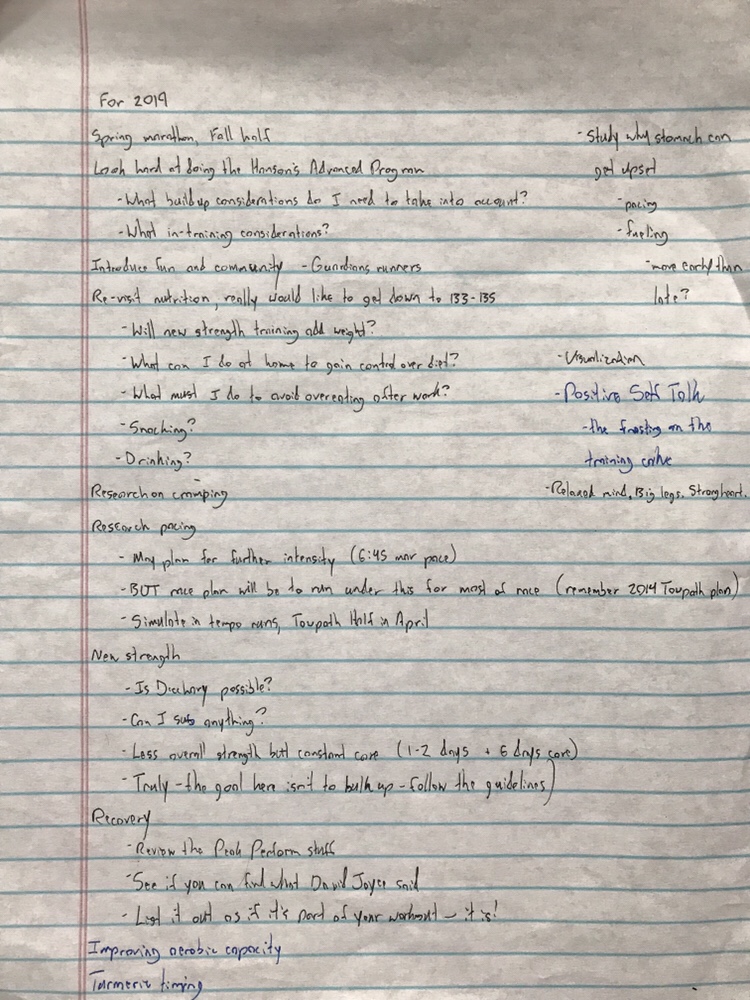
  3. Be brutally honest about where you could have made more progress. In my coaching life this is a stage I immediately want to jump into. In the role of a coach, I am usually able to quickly process the emotion of a game or practice and my mind immediately shifts toward solving any problems I observed. However coaching requires a receptive audience and someone who is still emotionally reacting to an event is not going to logically process any coaching points. Good coaching is about getting the most out of an athlete or client. If they are not in a headspace to be receptive to the advice, the best coaching points in the world are not going to result in any progress. Once you get to that place where you are receptive to a critique of your performance (self-guided or from a coach/boss/co-worker) you will see that there are areas where a positive but ultimately unsuccessful performance exposes previously unseen weaknesses in your preparation or in your performance. I remember interviewing for a teaching job at a school that utilized a wholly different way of teaching reading to students. I familiarized myself with the method and had some rudimentary ideas for how I could teach within the framework, but when I actually interviewed it was clear my understanding of the method was not as deep as the committee would have liked. I had spent more time planning to highlight my strengths and the time I spent on that took away from learning their method in more detail. When I interviewed for future jobs, I was more careful to learn as much about the school and its students so I could speak more deeply about the needs of that specific school. I made a similar appraisal of my running in 2018, spending several days with a legal pad nearby, jotting down all areas where I had made progress in 2018, but could push the boundaries in 2019. I eventually had a full page of items I felt I needed to either research or more carefully implement for my training in 2019. It was a difficult exercise, looking at areas where more careful attention could have resulted in better race performance, but it served as a foundation for creating a better training plan for 2019.
  4. Use your reflection to build a stronger foundation for your next performance. In athletics when people train improvement occurs, not during training itself, but during the recovery from the training. Hard lifting, running, and jumping all push muscles to a breaking point, creating micro-tears in the muscle fibers. This sounds bad, but it really it helps foster improvement. Sensing the damage, the body sends in repairing agents to the damaged parts during your recovery (largely while you sleep) and the result is that the damaged muscles end up stronger. Reflection serves as this recovery for you. The full page of weaknesses I identified helped me create a plan that is serving to guide my early training for 2019. I have started to build a foundation for a more intense strength training regimen. During my offseason or preseason, however you might label the months before my serious marathon training begins, I am running longer and harder, albeit still far below what I run at my peak, so that I can jump into a more intense early portion of base building when marathon training begins in late January. I am identifying the single most important aspect of my training on any given day so that I can focus on improving areas I have previously struggled with such as maintaining an even pace during speed work, something I think can help me ward off the late-race cramping issue that killed me this year. I have re-doubled my efforts to visualize the perfect race and how I can handle obstacles that may impede that perfect race. The focus here is on marginal gains, improving in small ways across the board rather than attempting to focus on a major improvement in one  area. I already have two very good marathons under my belt and they are worth celebrating. With some small gains in a few areas, I can turn those good marathons into a great one.
  5. Kick ass. The process complete, you know what you need to do. Go do it.

Disappointment sucks and the sting of doing well only to fail at the margins is especially draining. Use the framework above and your near-miss can be the foundation for a major success in the coming year. I congratulate you on a well-lived, well-run 2018 and hope you are able to kick ass in your own endeavors in 2019.

Happy running,

Adam

My reflections to get me ready for 2019

Three Lessons from a Breakout Marathon Performance

My Cleveland Marathon performance in May was a dream race – a breakthrough that earned me a Boston qualifying time (BQ for the uninitiated). You don’t earn a BQ without learning some hard lessons along the way. Here are the three most meaningful lessons from my training for and then racing in Cleveland.

 You Have to Put in the Work

The simple truths are the easiest to ignore. I learned this the hard way. Let’s begin with the obvious: anyone who trains to run a marathon puts in work, mountains of work. However the differences between training to finish a marathon and training with a performance goal in mind can be vast. My goal was always to qualify for Boston and if I wasn’t going to challenge for such a time, I wanted my training to push me to a limit, to lay a foundation I could use for a future run at a BQ. The training for my first marathon simply did not meet that criterion.

I made the mistake of overconfidence. I thought I had cracked the training code, that previous fast half marathons would equal fast marathons. I ignored gaps in my training and bad habits that I had accrued. I was lax in my approach to strength training. I avoided consistent mobility work. Rather than being proactive in my approach to staying healthy, I often responded to minor injuries and tried to patch my way back to health. Since I ignored the important extra work that delivers strength and health I was priming myself to line up at a start line on the cusp of an injury. That was that condition I was in when I raced my first marathon.

This time around, I put in the work. I learned from my mistakes. I adopted a strength program that I completed five times a week, emphasizing core, hip, and leg strength. I mobilized tight muscles. I stretched. I iced. Even now I continue to see a chiropractor twice a month, a sort of bi-monthly tune up that remains from the rehab that unkinked my spine after injuries and imbalances left it looking like a question mark. And I ran. More than I have ever run. No longer did I cobble together weeks from plans that had worked for me before. I read books and training theories and decided that the manic ideas of cumulative fatigue espoused by the Hanson brothers, they of the “short” long run, were right for me. It all led me to the start line in the best shape of my life, weighing what I once weighed in college, and confident that somewhere inside I was capable of running a BQ. All I would need to do was navigate the mental and emotional hurdles that a marathon places in front of you and I was sure I would meet my goal.

Feed the Good Wolf and You Can Write Your Own Ending

In his excellent book, The Champion’s Mind, sports psychologist Jim Afremow relates a Cherokee legend known as the tale of the two wolves:

A grandfather explains to his warrior grandson that there are two wolves within each of us: One wolf is positive and beneficial, while the other wolf is negative and destructive. These two wolves fight for control over us. The grandson is curious and asks, ‘Which wolf will win?’ The grandfather replies, ‘The one you feed.’

Having put in the work, I approached the end of my Cleveland training brimming with confidence. Roughly six weeks out from the race I was convinced I would meet my race goals. Yet I would learn in even this short amount of time that the smoothest training cycle can still present you with late bumps and hiccups. And on race day, 21 miles into the race of a lifetime, I would learn that in the span of a half-mile the wheels can come perilously close to falling off.

Rather than listing every problem I encountered, let me talk about one late training complication and a mid-race set back that each could have derailed my well-laid plans. The training complication occurred during race week. I grow a vegetable garden every year and unseasonably warm spring weather in Cleveland meant I was ready to start planting well before the late-May race date. I bought all my plants and spent one evening planting most of the garden. I assumed over the next two weeks I would find a day to finish the job. Then it began to rain. It rained and it rained and it rained. Then, just to change things up, it rained some more. For ten straight days it rained and my garden became a swamp. Finally the skies cleared and the garden mostly dried out. It was four days before my race but I needed to get my vegetables in. So I set back to work, dug up my raised beds, and finished the work. My reward was a completed garden and waking up to an incredibly sore right calf and an arch that seemed to be in a perpetual cramp-like pain.

The mid-race complication occurred somewhere during the 22nd mile of the race. At Mile 20 I had hit a mental wall. I felt lifted by the knowledge that I was two minutes ahead of my planned time and on pace to earn that coveted BQ. But the fatigue, both physical and mental, of covering 20 miles was draining. While only a short 10k remained, the prospect of running at this intensity for another 40+ minutes was daunting. I narrowed my focus. Cover the next mile, cover the next half-mile. That was when the cramps began. My calves began to pulse; I remember thinking that it felt like each calf had a heartbeat. A mental wall seemed to smack me again. It was all going to come crashing down. I was running the race of a lifetime and cramping was going to stop me in my tracks, and so close to the finish line. I was certain I was doomed.

Both of these problems had the potential to throw me off my game, to live rent-free in my head and leave me pondering how they would lead to disaster. Instead I concentrated hard on feeding the good wolf. Neither of the issues were insurmountable hurdles. Yes, they could become major issues if left unchecked. I approached each problem with a three-part strategy to make sure that did not happen:

  1. Assume I brought something to the table that would allow me to overcome the problem.
  2. Concentrate on doing the first positive thing I could to solve the problem.
  3. Assume it would all work out.

What did I bring to the table that would solve the pre-race calf pain issue? I knew I had not worked it too hard. I had not felt any acute pain during the work, so I assumed it was not strained. I had worked it in a different manner from how it had been used to accrue the hundreds of miles I had covered in my training. I knew in cases like this, delayed onset muscle soreness (the sort of soreness you may feel if you workout after prolonged time off) was a distinct possibility. What could I immediately do to solve it? I could heat the muscles to relax the pain. I could take NSAIDs to fight inflammation. I had no guarantee that this would work, but so close to the race, there was no point worrying about the outcome. I could only do so much. I needed a clear head and to focus on the positive outcomes I had spent months training for and visualizing. I assumed everything would work out. On race day, I woke up pain free despite some lingering soreness that had plagued me the day before.

Trying to execute this process was harder in the middle of the race. Races require hundreds of micro-decisions. Ignore that jolt of pain there, pay attention to this spasm here. Surge now, hold back now. Hey, that’s a cool sign. Stop, focus on your pacing; you fell off a bit during that last mile. It is taxing. The dread that consumed me when my muscles started to cramp was difficult to throw off. I knew that initial spasms could eventually result in the muscle fully seizing up and becoming rock hard. If that did happen, I was done. I remember pondering whether or not I should stop and massage my calves. I ignored that impulse. Despite the cramps I was still running well and wanted to maintain that effort as long as I could. What did I bring to the table that could solve the problem? I knew cramps could be caused by dehydration. I was coming to a water station soon. I needed to drink as much as I could. I also needed to free myself from the notion that I was going to seize up. Yes it could happen but that was not guaranteed. I did all I could to keep that worry at bay. How? By focusing on what I could do immediately. I could keep running. I could cover the next half-mile. I could cover the ground to the next stop sign. The last part of the course introduced some short but taxing hills. At times my focus narrowed to worrying only about making it several hundred feet up a hill. The pulsing came and went. Somewhere in the 24th or 25th mile my hamstring decided to cramp too. It completely deadened and my leg would not extend backward. I kept to that narrow focus. Just move forward, no matter how awkward. How did I assume it would all work out? I knew from my previous race experiences that my body tends to unleash a rush of adrenaline during the last mile or two of a race. If it responded that way today, I would be fine. Luckily it did and my last mile passed in a blur. I hit my goal, that wonderful Boston qualifier, a 3:05:11. It was as good an ending as I could have ever written.

We Are Meant to Go All In

Entering Cleveland I had mapped out a specific race plan in my head. Before dropping into my goal race pace, a 7:03 mile pace, I wanted to run the first four miles 15-30 seconds per mile slower. I had learned from bitter experience that I sometimes emptied the tank too soon, leaving me spent and sputtering at the end of a race. Also, large races with large race fields often are so congested early that getting into a comfortable rhythm is almost impossible.

Instead of feeling free and easy during those early miles I felt tired and sore. This made no sense. My taper was supposed to have helped me heal from the last four months of pounding. Instead of turning on the jets as I entered the fifth mile, I continued to lumber through my leisurely pace, my hamstrings sore, my back achy. This made no sense, but I had also reached an important decision point. I had trained for a year for this day to make a run at qualifying for Boston. My training told me I had the fitness to make that challenge. Yes, I had 21 miles left and yes I was worried that if I felt bad now, I would likely struggle to make it through those next 21 miles, but I would never forgive myself if I didn’t go for it and see what happened. As I passed the Mile 5 marker that denoted the start of my sixth mile, I surged my pace until I hit what felt like the right rhythm. Instantly the feeling of running through quicksand disappeared. I felt strong and my running felt effortless. It seemed after months of training to make my race effort feel almost second nature that my body was incapable of being happy running at anything less than its best. Life, I suspect, is similar.

We all need periods where we coast, where we rest. But ultimately I think we are very much aware of when we are pushing ourselves to our limits vs. when we are coasting, just getting by, or holding ourselves back from something better out of fear that it could go wrong. And I suspect that much of our happiness comes from this. Yes we may fail, we may make mistakes, but we live when we go for broke, be it at work, in our relationships, or in our passions. It is why even two months later I still remember the feeling of picking up my pace as I passed that Mile 5 marker and taking off into an unknown. I did not know what was going to happen, but I knew now that I was giving it my all. I rode that feeling all the way to the finish line and a breakthrough.


A Quick Note

Think the idea of writing your own ending sounds way too good to be true? There is some science to back up the idea, at least in distance racing. One of my favorite sports science writers, Alex Hutchinson, in Outside Magazine, reviews a peer-reviewed paper by Italian physiologists who linked higher emotional intelligence scores to better half marathon race times. Essentially a pre-race test rated runners and their abilities to monitor and regulate their emotions. Those testing better at regulating emotions ran faster half marathons. In fact, Hutchinson notes, “Their scores on this test turned out to be the strongest predictor of their race time the next day—even stronger than prior race experience or typical weekly training mileage. Pause for a moment to let that sink in.”

Interesting stuff.


Happy running,


Adam

On Returning and How Watching Lebron and Handling Injuries Made Me a More Mindful Runner

There is a moment this past April where I’m finishing up the last interval of a strength run, 2 x 3 miles or 3 x 2 miles (I can’t remember which) at 10 seconds faster than marathon pace. I look at my watch, the seconds ticking along as I feel my legs rolling over beneath me like a metronome. Left right left right left right left right at a steady 186 strides per second. I’m going to nail this workout, I realize, as the end point for this interval looms in the early morning fog. I have had this thought during almost every workout in the last month as I keep hitting splits. It hits me that I fully believe that I’m going to do it, that I’m going to qualify for the Boston Marathon at the Cleveland Marathon in May. I don’t think I am going to do it, I know I am, that’s how I feel. As I click my watch at the interval’s end (my time right where I want it) I take a moment to savor that feeling, that utter confidence. Then I remind myself to enjoy this, this feeling of invincibility, that the road before me is mine to conquer. It has been years since I felt like this…


I began writing this at my desk the day after Lebron left my city again and in the two weeks of reflection since I found much of the experience of watching him the last four years mirrored my own recent running success. I expected him to leave, I prepared for it, but that does not lessen the pain. All-time great players do not come around often to a city like Cleveland. I took for granted the opportunity to watch him play his first time here and so when he returned I knew it was a moment to savor. Lebron would inevitably be gone again, whether through free agency or as a victim of Father Time, so it was important to recognize the moment for what it was: a second chance to behold the extraordinary.


A lifelong Clevelander, I took Lebron’s first stint here with Cavs for granted. I believed no one could stop his ascension to best player in the league. Clevelanders, all of us, took it as certain that he’d win us the championship we’d long craved. We’d win with him, you’d see. And then he was gone, wearing a black and red Miami Heat jersey.


I was similarly confident during my first years of serious running. After an up and down few years getting to know the sport, I really came into my own in 2014 and 2015. I crushed my half marathon PR multiple times, was running free and easy and fast and dammit nothing would get in the way of my progress. I signed up for the 2016 Cleveland Marathon and surely a smashing marathon debut was in the making. Instead I physically broke down, maybe from a sporadic training plan, maybe from a pattern overload as years of bad form caught up to me, maybe because an imbalance from a previous glute injury, hidden and festering for years, finally caught up to me. Whatever the cause, where a fast, steadily improving runner had entered 2016 raring to go, I crossed the finish line of that 2016 Cleveland Marathon broken and diminished.


Like those intermittent years after Lebron’s leaving were a disaster for the Cavs, full of starts and stops, so too was the time that came after the disappointment of my marathon debut. Yet both events helped me reset what I expected from my experiences as a fan and as a runner. Moments that might seem small during the moments when everything is clicking become treats when little seems to be going right. My basketball team was one of the worst in the league? Well at least that draft pick seemed to be panning out. Hey, we put together a short win streak. Fantastic, we beat Lebron’s Miami team (and on the day before my birthday no less!). I’m an injured wreck and haven’t been able to run consistently in a year? Suddenly that 6-mile run, a short jog when training is going well, became a luxurious long run that enabled me to see something, anything, more than the mile or so from the door I’d been running while trying to get back to full health. The opportunity to even jog through a race, an actual race with other devoted runners was heavenly, when it had been nine months since I last dared to toe a start line. Yes, during those bad times for the Cavs and during the moments in 2016 and 2017 when I was a shadow of my former running self, I learned and embraced the need to be mindful of anything good I could experience. It is why when Lebron announced he was returning in 2014 I was keenly aware that I was being given a second chance to enjoy watching the sport being played at maybe the highest level the league has even seen. For Clevelanders it culminated on June 19, 2016, with the city’s first pro sports title since 1964. After entering Game 5 of those NBA Finals down 3-1, the week that would encompass Games 5-7 would be, for many Clevelanders, the great sports week of our lives. And it is why the last eight months or so, when I have returned to that strong runner I once was have been equally rewarding.


Which brings me to why I am writing this post and why I have returned to this blog. It has been roughly two years since I wrote about my running and as much of those two years were full of frustration, starts and stops, nagging pains, and trips to doctor’s offices, I lost touch with the purpose I had for writing this blog, the idea that I could help others with their running if I shared my own ups and downs as a runner. One of my biggest faults is that when I lose track of my purpose I tend to stand still and I am most guilty of that right here, in this space. However, by being far more mindful of the highs running can provide, even in the darkest of times, I have returned to reconnect, to share my running journey with any readers I may have. I have enjoyed several successes in the last few months but I am not back to brag. Rather, I am back to perform a sort of autopsy on the last two years of my running, to share what didn’t go well and the required adjustments I had to make to get myself back to being the runner I have always wanted to be. In the coming months, as I share my preparation for the Columbus Marathon, I will also be sharing information on those two years, including:

  • How I built back to full strength and fulfilled a life-long dream of qualifying for the Boston Marathon in the process
  • Why strength training is so important for runners and why I am a believer in Jay Johnson’s SAM programs
  • Why daily mobility work is so important and why I am a believer in the work that people like Kelly Starrett and Jill Miller are doing
  • Why I run using the Hanson’s Method and why I believe a progressive program is important for meeting your running goals
  • Why I love the Cleveland Metroparks and the Cuyahoga Valley National Park and the great race series the Canalway Partners put on every year
  • Why I see a chiropractor and why I believe one is a solid investment for any athlete
  • Various thoughts on running, runners, competition, performance, and really anything that goes through my head as it may relate to improved running or performance


Two weeks after he left it doesn’t feel any better that Lebron is gone, that the run I have enjoyed during the last four years is over. However it is a run that provided some of the best sports memories in my lifetime. I am mindful of those memories and mindful that more good can come, that while the coming years will be different, there will be bright spots. Luckily in my running life I still seem to be in the middle of a good stretch, where each day I feel strong and capable of taking on whatever workout I have planned. I will be mindful of that too because I have slogged through the long, trying wilderness and I am trying to avoid it again for as long as I can.


Happy running,


Adam


Ecstasy and Agony: Inside My Head During the Cleveland Marathon

Inside my head during the Cleveland Marathon, my first marathon…

Starting Line: Here we go. Here we go. Here we go! Five years of running and my first marathon! Oh my lord it’s cold. It’s May. I know it’s Cleveland but it’s May. Why is it so cold? Where is everyone? It’s 20 minutes until the start. (Note: everyone is inside Quicken Loans Arena, warm, unlike me, who is freezing in the cold waiting).

Ok, we’re finally almost there. Everyone has left the warm embrace of the Q. The VIP’s are getting in their good lucks and thank you’s and YES! Here we go! Everyone is moving forward, I’m underneath the banner and I am off!

Miles 1-2: I’m up front. Not too much congestion here. That’s good. Can’t wait until the construction on Public Square is done. The designs look beautiful. Legs are feeling good. I’m trying to keep my pace easy and slow right now; do not want to start out too fast like the half marathon last year. Turns are a little tight, slowing me down, but that’s ok. I feel relaxed. Relaxed is the name of the game today. Stay relaxed and kill it at the end.

Miles 3-4: Oh man, here’s the wind the weathermen were predicting. And it’s hailing now (wind and hail/snow would be an awful pairing all day – when the wind hit, snow and hail were not far behind).

Miles 5-7: Tremont, you are one of my favorite parts of this race. I love your crowds, the tight knit neighborhood feel. This right here is one of the best reasons to run this race, this section with these people right here. This is ecstasy. Running ecstasy.

And I’ve picked up a running pal who, like me, is hoping to qualify for Boston, and only three weeks after he ran his first Boston Marathon. Let’s settle in and pace each other for awhile. Still feeling good, feeling relaxed. This is exactly how I wanted to feel at this point in the race and I have someone to keep me moving forward when things get tough. Only good things can follow.

Mile 8: Nope, plenty of bad things can follow. Here’s the wind and snow again, and something else, some discomfort in my right hip…

Miles 9-10: Oh man oh man oh man oh man, this discomfort in my hip cannot be good. Is it my flexor? My adductor? I’m not sure but it’s this nagging ache toward the front of my hip. I’m talking to my running pal from Columbus trying anything to take my mind off of the building pain. Please please please let this not get any worse. Just give me another couple of strong hours. It’s all I ask for.

Mile 11: Mother Nature, you and I are going to become mortal enemies right here. That latest wind gust had to be 25 mph or more. I feel like I’m running in place. God bless the people out on the streets supporting us. I’m miserable and I’m moving. They have to be miserable, just standing there. But they’re toughing it out. Thank you so much, folks, you’re helping to keep me going right now.

Miles 12-13.1: Pain in my hip seems to be subsiding. I feel good again. I feel great. The wind has died down again. I started to pull away from my running buddy. Good luck my friend, I hope you qualify for Boston and get back there. I’m feeling ok so I’m going to push this a bit and make my own run at a BQ. Holy hell, I just run my third fastest half marathon ever. Strong and relaxed. Strong and relaxed. I don’t feel like I just ran a fast half marathon. The miles in training paid off. Well, I’m halfway through this thing (this, in retrospect, would be the high water mark of this race).

Miles 13.1-16: This was the start of the section I was dreading when I saw the winds would be bad. A solid five miles directly into the wind. Here it is again. Fresh bout of hail/snow. God bless the spectators. So many helping us push forward. There’s a pace group up ahead. Is that the 3:05’s? The 3:00’s?!? Holy cow, am I stalking the 3 hour pace group? Oh man let this hip pain stay away, I’m feeling so good right now. I could do this. I could actually do this. Legs are beginning to feel a little heavy. Expected that though. Just focus on getting to the next mile. Always the next mile. You knew this was going to test you. Just please stay away, hip pain. PLEASE!

Mile 16: Nope. It’s not staying away. That is awful, that is horrible. Just keep pushing, just keep pushing, keep moving forward, keep forward, see if the pain goes away again.

Mile 17: Pace just dropped a bit, not too much. Maybe it will be alright. The turnaround is coming soon. No more headwind in a half mile. Oh jeez, that’s a rough gust of wind. Such a lovely parting shot before I turn around. Oh god, the outside of my right hip just tightened, and now it feels as bad as the front of my hip. I have how many more miles?

Mile 18: There it is. Time to stop and walk. Oh my lord the pain is excruciating. Where was that med tent I saw earlier? Mile 19? There goes my running buddy from earlier. Good luck, my friend. Get that BQ. It’s not going to happen for me. Just keep moving.

Miles 19-21: This is agony. Running agony. That wind might be at my back but it is still a killer. Gusts and gusts and gusts. And it’s at its worst when I stop to walk. I am so cold. My shirt is soaked. My hat is soaked. My gloves are soaked. I cannot feel my thumbs. But only my thumbs. Weird. Was that thunder? Was that actually thunder? It’s snowing again. Thunder snow in May. My god, Adam, if you finish this race it’s one you’ll never forget. How can you forget the time you ran a marathon in thunder snow in May. Still a lot of spectators out. Folks, I’m freezing. A tip of my cap to you for sticking it out, watching us. This stretch seems to be going on forever. Where is the turn onto Edgewater?

Mile 22: There it is. Four miles left. Walk. Jog. Walk. Jog. Pain pain pain pain.

Mile 23: Oh thank you, Lord, the Shoreway has arrived. Man, I was hoping to hit this stretch feeling so strong, ready to test myself through those last three miles, to see if I could hit that fast finish. Not today. Oh well. Finish this first marathon. Get that medal. Oh man, my knee hurts now too.

Mile 24: Gotta stop and walk for a sec. These last two miles may take until June. There’s a guy stopping next to me. He wants to pace it out together. Ok. Maybe a friend here can make this go by faster. Turns out this guy, Chris from Michigan, he was hoping to BQ too. Tried and missed in Toledo a few weeks ago. Guess today isn’t going to end the way either of us wanted it to. Ok, Chris, I’ll keep moving with you. Can we walk a sec? Ok. Thanks. Jog again. I can see the banner for Mile 25. We’re almost a mile away.

Mile 25: Oh Lord that tailwind just flipped back and hit us in the face, as we go up a hill. Mother Nature, we will never be friends again. This is lower than low. Way to kick a man and 15,000 of his running friends when they’re down. I want this to end. I’m so close. Chris, man, let’s get this over with. I can see the downhill. We’re going to see the finish line here any moment!

Mile 26: It’s there it’s there it’s there! Less than a quarter away. Let’s wrap this up and get warm. Wait, Chris found his wife. Wait for him. No, it’s ok, Chris, I’ll wait. We’ll cross together.

Finish Line: It ends. Mercifully. Quick picture, Chris. Thank you, my new friend. You helped make the end possible. I am cold. So so cold. I don’t think I will be warm for a week.

Mile 26.3 and beyond: Since Sunday I’ve had some time to decompress, bundle up in about five layers, and I have these initial thoughts about the race. In the coming days I will more carefully detail what I think went right in training and what I think happened that led to the race going so wrong. These, however, were the things that stood out the most after finishing this Most Cleveland Race Ever.

1. In the days after the race many posts on the race’s training group’s Facebook page described the many triumphs and personal bests runners achieved on Sunday. I continue to be amazed at all of my fellow participants. Sunday was a brutal day to run in and yet the fact that so many persevered and excelled is testament to the spirits of the runners I had the pleasure to share this race with. We will always be connected by this race. Congratulations, again, to everyone who survived Cleveland.

2. Sunday was truly ecstasy and agony, hence the title of this post. I finished my first marathon. It’s impossible to complain about that. The distance is humbling; it takes so much effort to prepare for. But this will always be a race that carries a great deal of disappointment. My training went so well. It predicted a very fast time. That half marathon split was achieved with me feeling relaxed and strong, totally within myself, exactly how I wanted to feel during the race. After the eight-mile disintegration of my hip adductors was the worst ten miles of running I can ever recall. It was a slog of walking and jogging. The temptation to walk away was strong. The medical tents were right there. But this was my first marathon. I had to finish. And I did. I think I hurt my IT band to cap it all off, but I finished.

3. Hey Mother Nature… ::censored obscene gesture::

4. No really, it snowed on us. In May. With winds that gusted at 25 miles an hour. Mother Nature and I are in no way cool right now.

5. The event, the volunteers, the spectators, it was all so well done. The respect I have for the people that stood outside to cheer us and support us cannot be overstated. I was freezing and I was moving. I can’t imagine how cold it had to be for the many who stood out there for hours and brought us home. It was moving.

6. One of the things I love most about running is that provides you endless opportunities to set things right, to get better. Sunday was an accomplishment, but one that did not meet my lofty expectations. It is Friday now. I have regained the ability to walk again. I feel ready to try a short shakeout run tomorrow. Most importantly, I have had time to think about the things that went right and wrong in my build up to this race and I’ll be sharing my thoughts on my training in the next few days. My injuries show I have imbalances and weaknesses to work on if I want to go the distance in the times I envision. I will. I’ll get more efficient with my mobility, add to my strength training, and find ways to improve that I hadn’t considered before this race. And I’ll run. I’ll pile on the miles when I’m ready. My fall race is only five months away.

7. Five days later and the end of the race, when a perfect stranger took the time to stop and slog through those last two miles with me, remains my favorite memory of Sunday. I suspect it will remain a top running memory for a long time. At Mile 24 I knew I’d finish, but this incredibly kind gesture had an oversized impact on my ability to get through those last two miles. I will forever be thankful for his kindness. Chris, someday soon I’ll see you at Boston. Thank you.

Training Journal: April 4-April 24 Peaking

The last three weeks constituted the most challenging three weeks of the spring’s training block and really, of the five years that I have run. In three weeks I tallied 140 miles, ran the longest single run I have ever run, and strung together workouts that demanding a leg-crushing combination of stamina, speed, and strength. I expected to walk out of Peak Week stiff and sore but instead emerged feeling strong and confident.

A Not-So-Great Tune Up

In the past I have run a tune-up race near the end of my spring training cycle. It is a nice way to get back into the swing of racing, to break the death grip that cabin fever can bring over me during unpredictable Cleveland winters, and to test my fitness before my spring race. When I was training for half marathons, I would run the Towpath Five Miler in place of that week’s tempo run. I would race slightly faster than tempo pace, but the race is short enough that it did not require any significant drop in mileage in the weeks before or after the event. In the past I have run this event at full speed and run it well. It has been a nice boost to my confidence heading into May.

Having moved up to the marathon, I decided I would bump up to the Towpath Half Marathon as a tune up race. Here I was left with a conundrum. Five hard miles was easy to fit into my training schedule without needing to cut mileage. A half marathon would not be so forgiving. I could either run the race at an all out effort, meaning I would have to trim mileage before and after the race, or I could run it as a workout. I decided on the latter.

Race day was frigid with temperatures below freezing. The photos from that day are funny; I look like I am preparing to trek through a distant frozen tundra rather than racing through a valley in Northeast Ohio. Cruelly, the weather the very next week would be sunny and 70. Spring in Cleveland. I opted to start fast and log my tempo miles early, a change from my usual routine of warming up with several miles and then turning on the burners, but in line with what my actual marathon will look like. I knocked out eight miles well enough, but then had to endure the planned slower five miles on tired legs while trying to stay warm in the frigid air. It was less than enjoyable. When I race, I do it to run well. This was the first time I really entered a race without meaning to compete, all out, from start to finish, and I found myself disappointed. I felt no sense of accoplishment at the end (though I accomplished what I wanted to that day). Maybe as I continue to train for marathons and become more acclimated to the pounding I will be more open to tackling a race like this with more gusto. In this case, however, despite running on one of my favorite courses in Cleveland, I felt underwhelmed, an unusual occurence during this cycle.

Keeping Things in Perspective

When something goes bad you often here the phrase that _______ is not a sprint, but a marathon. This is true, literally, for a marathon and also for marathon training. Three weeks ago I tackled my second 20-mile run in as many weeks. Still new to this distance, I was conservative in the early going but as the run went on and I felt strong, I began to push the pace a bit. This has been typical of my long runs this year. Disaster struck at Mile 18. My muscles began to cramp horribly. The asphault I was running on was surely turning to quick sand. This was a run worse than death. I wanted to stop and curl into a ball right there on the side of the trail. Somehow I dragged myself to my car and managed to navigate my way home.

My first instinct was to panic. I coulnd’t even finish a 20 mile run. Getting to 26.2, and in a decent time, felt like an insane idea. But like I said, marathon training itself is a marathon and in a week’s time this bad workout would be erased. I returned to the same path I had so spectacularly crashed on the week before. Again I started conservatively but only a few miles in I could tell I was going to feel strong. The workout was only for 16 miles and my legs were showing no fear of the distance. Earlier in training I would become obsessed with maintaining a certain pace, pushing myself beyond discomfort to hit a time that meant I was feeling stronger. However after logging more of these longer runs, I’ve discovered that my best workouts happen when I listen to my body and let the pace come to me. So that’s what I did. Miles melted away. As I turned back at the halfway mark I was pushing a pace near the 7:30’s but it felt effortless, or as effortless as it can feel on legs that are going to be pushing for 16 miles. Five miles from the finish I was dropping into the 7:20’s and held it. Two miles out I was into the 7:10’s and tiring, but not from the pace but rather the distance. I finished relaxed and controlled.

Peak Week

Running relaxed and controlled has become my focus now and as I entered Peak Week my focus would be on making each mile as relaxed and controlled as I could be on legs that were being asked to log 51 miles in a week, a new personal record.

The week began with a 22-mile run. Wanting to build mental toughness for the end of the Cleveland Marathon, which asks runners to deal with a final hill just before the finish, I returned to a course that would start me with a four-mile downhill stretch that would become a four-mile uphill stretch on the return. The first six miles were a struggle. I could not seem to get my blood sugar under control. I focused on staying relaxed, guessing that as I continued running and fueling how I felt internally would straighten out. They did. With this being my longest run of the cycle, I made sure I did not push the pace, wanting to have plenty left for the hills at the end. My goal in May is to run the first half of the marathon in this manner, settling into a rhythm that feels almost effortless before I spend the second half pushing things a bit. At the turnaround I felt strong and I naturally started to push the pace, though in a more relaxed and controlled manner than was usual of my earlier training. No big drops in time, just maybe five seconds per mile shaved off. At Mile 17 I began to hit the hills, at first just a a gradual climb and then a brutal 11% grade that I had to slow down to scale. I survived and tackled the last three miles strong and with satisfying splits. I shuffled a bit at the end but all told I consider it my best all around run of this spring’s cycle.

Next came a tempo-hill combo. Eight miles of tempo runs were split in two and preceeded by 4 x 20 second hill sprints. Again, I wanted to make sure I was relaxed and in control during my tempo runs. I have had a problem with pace discipline during these runs, pushing the envelope too far at times. I wanted to make sure I did better at locking in on my race pace and saving energy for the last few tempo miles which would prove to be daunting on tired legs. The workout built a lot of confidence as I logged my miles and at a pace that felt sustainable. I am becoming better at welcoming the discomfort that comes at the end of these workouts, realizing that the more I embrace it in training the less of a shock it will be in my race. I am especially trying to use the end of training runs to visualize what I will be feeling beyond Mile 20 in my marathon. As I hit the last two miles I had to spend a good deal of mental energy keeping my body moving forward at the pace I was running. It no longer felt easy (or as easy as tempo miles can feel) but with a sharpened focus, it didn’t feel like anything I would be unable to handle. My last mile would prove to be my fastest.

My final key workout of Peak Week was a set of Yasso 800’s, six of them, dropped into the middle of a 10.5 mile run. I had done an earlier set of Yasso 800’s three weeks earlier and my times, averaging about a 3:04 had been promising, though a strong headwind that day left me feeling that my times could have been improved. On this day, the wind was far tamer. I felt confident I was going to get a solid read on my fitness. I was not disappointed. My first interval, a 2:59, would be my slowest. As I got used to the pace my times dropped significantly. I ran several 2:51’s and would stay under 2:55 until my final interval, which clocked at a 2:58. Most promising to me was that, like the rest of the week’s runs, I was running strong but in control at the end. My legs were fatigued (I was wrapping up a third hard workout during a 51-mile week) but my form remained strong.

And so now begins the taper. Mileage the next three weeks winds down and, as of this writing, my race is in 18 days. I am not quite sure what to expect, only because I have not covered the distance in a race before. But overall I am happy with my training and I am going to choose to trust it. We’ll see what happens.


Weekly mileage the last three weeks: 42.1 miles, 47 miles, 51 miles (Peak Week)

Mileage covered so far this year: 527.2 miles


Training Log: March 21-April 3

Going Where I’ve Never Gone

These last two weeks were weeks I have been waiting for. I reached weekly mileage I have only touched on two or three times previous in my training. I ran long runs that were further than I have ever traveled. Two weeks ago it was an 18-miler. It was an unseasonably warm day and I headed to the Cuyahoga Valley and a part of the Towpath that I have tackled some of my previous longer long runs on before.

The run itself went better than I may have hoped. I kept to my normal pace, around 7:50 per mile for the first eight miles. The miles felt effortless. Unlike in previous years, where I would approach ten miles and start to anticipate the end of the run, on this day no such thoughts crossed my mind. It was the first time I felt like a true marathoner. I did not want to finish; I wanted to see how strong I could stay in the coming miles.

After the ninth mile, I looked at my watch: 7:36. I had dropped 15 seconds off my pace. And there the pace would stay. Though I knew I was pushing the envelope at this pace, I did not feel I was working particularly hard. I have been working hard to stay aware of my fueling needs and, when I felt my blood sugar dropping around Mile 13, I took a gel and my pace never diminished. In all, I would finish running 18 miles at a 7:43 pace, very encouraging for such a run.

A week later I attempted my first 20-mile run. Overall the run was another success. My pace was only six seconds per mile off of what my previous run had been. Even better, I had purposely planned this run for a hillier course than the previous week’s outing, with the first four miles largely being downhill and the return journey ending with a four mile series of small and large climbs.

I feel I made a misstep during this run however, putting too much stock into the times I had posted the previous week. Part of what had made my 18-mile run so promising was that I did not really plan to run the splits that I did. I simply felt strong, ran composed, and the strong splits were a result. For my 20-miler, a run I had already planned on being more punishing with the hills, I consciously tried to match my times from the previous week, twice running miles that were under 7:20, a pace that is closer to my race pace than my predicted long run pace. Worse, I was putting forth far more effort to maintain these paces than I had put in the previous week.

If I had planned a fast finish run, where the end of my long run was intended to come close to these sort of higher octane paces, that would be one thing. That was not my intent. My intent was to tire myself out and then see how I handled the hilly finish at the end of the run, mirroring the sort of finish I will face at Cleveland in May. Well I was tired when I hit the hills, but more tired than I should have been and it finally cost me. After a climb less than two miles from the finish I had to take a quick break and walk. The walk was not long, maybe three minutes or so, but the intent of the run, to leave something in the tank at the end to power through all the final climbs, was not quite met.

So lesson learned. My 22-mile run in two more weeks, the peak of my marathon training long runs, will also feature a hilly conclusion. I suspect I will be slightly less interested in racing myself into a tired leg frenzy before I actually tackle the whole point of the run.

Juicing Up the Fast Work

Though they are my least favorite sort of workouts, I have come to develop tremendous respect for tempo runs. Tempo runs build endurance by forcing your body to learn how to fight fatigue in the presence of hydrogen ions that are released into the body during exercise. In the past I have struggled with these runs, often run at a perceived exertion of 8 out of 10. However, last year I decided that I would not only tackle this type of run, I would make it harder. I did this after reading an article from Competitor Magazine senior editor Mario Fraioli. The article, which you can read here, describes a workout called a tempo-hill sandwich. The basic outline of the workout is that you run warm up miles, then run 3-6 hill repeats of 20 seconds, take a quick active break, run half your planned tempo mileage, take another quick active break, then repeat the hill runs and tempo run. The hill runs emphasize speed, power, and explosiveness right before you subject yourself to a workout that emphasizes aerobic endurance and becoming comfortable with being uncomfortable for a long period of time.

Basically you get your butt kicked but get more out the workout with the combination.

The workout is so hard that in the past, especially in warmer weather, I have struggled to finish it.

Two weeks ago, though, I conquered the monster. I ran the workout as described and was surprised to see how effortless it was to run at tempo pace, at times well under tempo pace, which I had to pull back on (don’t leave your race in a workout).

Then last week I tackled a full seven miles of tempo work. The workout went well, though a train crossing delayed me for a good five minutes or so two and a half miles into the workout, negating some of the planned discomfort the workout is supposed to provide. Still, I finished my final miles running hard, right around my half marathon pace, and feeling strong and in control.

Something to Worry About

I noted in an earlier training log that foot pain in my right foot had forced me to the sidelines for about ten days back in January. Since that time I had the problem largely under control. Following my 18-mile run though, pain started to linger again. This coincided with my weekly mileage creeping into the 40+ mile range and I think it was in part due to the condition of the track during that long run. The Towpath is largely crushed gravel on a dirt base. In the summer this is largely smooth. Though the track was dry for my long run, the effects of a wet winter left it full of ruts, foot prints, and divots that had all hardened. These were not enough to turn ankles or cause me worry over my footing, but I noticed my toes clenched more often to find better footing. The pain was noticeable the next day.

So far the irritation is just that, irritation. Nothing I cannot handle and nothing that, so long as I am wearing shoes, makes me think this will be anything more than a nuisance.

I am less than six weeks away from my race. I am running strong. The irritation is not noticeable when I am running though some pain creeps in when I am done. Unless this exacerbates into something more over the next few weeks, I cannot imagine I will deviate from my course. We’ll see.


Mileage over the last two weeks: 42 miles, 43 miles

Mileage so far this year: 387.1 miles

Training Journal: March 14-March 20

Respect the cut back week

This was a week for stepping back. My long run shortened up a bit. I ran fewer hills. My race pace run added another mile at race pace but the overall volume did not change. I even cut back on a recovery run day, opting to give my feet a break.

These are the weeks I was never good at when I first set out to run. I wanted to go 100 miles an hour every week and struggled with staying healthy and motivated. Slowly, and painfully, I have come to realize that progressing as a runner isn’t about going full out every run every week but saving yourself for the key workouts that really matter. So I stepped back this week, from mileage in the high 30’s to back in the low 30’s because next week’s training ramps up as the push to get to Peak Week begins in earnest.

Preparing for what is ahead

The next few weeks are some of the most anticipated weeks of training I will be tackling since I started running. I will be tackling weekly mileage that I have only attempted two or three times in the five years I have run. Next week begins a string of long runs that will be the farthest I have ever traveled. It is as if I am crossing over a threshold from being a half marathoner to a full on marathon runner.

I am venturing into the unknown where I do not know what to expect or how I will handle the strain. I am looking forward to seeing how I hold up to the pounding my legs are going to soon be taking.

I follow several runners on Twitter and one of them (for the life of me, I cannot remember which) posted the following quote, which sums up how I am feeling heading into the last eight weeks of training:

“When you’re a competitive runner in training you are constantly in a process of ascending…. It’s not something that most human beings would give a moment of consideration to, that it is actually possible to be living for years in a state of constant betterment. To consider that you are better today than you were yesterday or a year ago, and that you will be better still tomorrow or next week or at tournament time your senior year. That if you’re doing it right you are an organism constantly evolving toward some agreed-upon approximation of excellence. Wouldn’t that at least be one definition of a spiritual state?”

-From Again to Carthage, by John L. Parker, Jr.

The journey to May 15th continues…


Weekly mileage: 33 miles

Yearly mileage: 302.1 miles


Training Journal: March 7-March 13

Simulate Your Race

A nearby resident enjoying the unseasonably warm day would have heard a crazy man shouting. “COME ON! IS THAT ALL YOU’VE GOT?!?!?!?!” That resident then would have seen a runner, haggard, his hair a windblown mess, trudging up the steep slope of a hill.

That runner was me. Yes I was shouting, not at anyone running with me, but at myself. No, I’m not crazy. Or too crazy, that is. But at the end of a punishing 16-mile run that I designed to conclude with a four-mile climb, my legs and lungs were rebelling and I had decided I needed a little vocal encouragement to finish my task.

Any quality run offers the opportunity to simulate an element of your race. While the course for the Rite Aid Cleveland Marathon is relatively flat, it does feature several hills, including a brutal final climb during the last two miles of the race.

To simulate making a lengthy climb while tired I planned my 16-mile long run as an out and back run, going downhill over the first four miles or so, traveling the next eight miles (including a turnaround) on flatter ground, then finally enduring a tiring four-mile climb to finish up the run. The climb is an exaggeration of what I will be tackling in May, but completing it built confidence in my fitness and in my ability to maintain a steady pace while battling the fatigue that comes at the end of a challenging run.

But Don’t Overdo

Adding in the climb was a great challenge at the end of the long run, and I may have overdone a bit. Shorter hill runs have been a staple of the base-building phase of my training and two days after my long run (with the end of run climb being an adjustment I added in) I was scheduled to run eight miles on a hilly course. My legs did not feel ready. With each step my calves felt like they were enduring the concussive blasts from fireworks. Step. Boom. Step. Pow. Step. Crackle. I probably should have just run a flat eight mile run. I did not, not wanting to stray from the plan (counterintuitive since my adjustment to my long run had already led me to stray from it).

I completed the run, but my legs felt flayed. I dealt with little aches and pains, especially in my calves, all the way through the weekend. It was a none too subtle reminder that training walks you along a rather thin line between being too easy and being too punishing. Drop a couple of challenging runs and you will not progress much. Add too many in and you will increase your injury risk. I will be smarter with the little tweaks I make in the coming weeks.

Work Down To Your Goal Pace

Like most runners I am obsessive, especially about hitting my splits. I have always struggled the most to hit my goal times during tempo runs. Yet, in the past, I have been unwilling to yield any ground. If a workout calls for five miles at tempo pace, I want to hit that pace for every mile.

The only problem is that I have a proven track record of getting stronger as I run. When I have expelled too much energy early on trying to hit my tempo splits, my tempo runs usually end up looking something like this sample eight-mile run (with five miles planned at tempo pace):

Miles 1 and 2 (warm up miles): 18:00

Mile 3: 6:40 (target half marathon pace)

Mile 4: 6:40

Mile 5: 6:45

Mile 6: 7:15

Mile 7: Death, I mean, 8:30

Mile 8 (cool down mile): 9:30

The end result is a workout that 1) doesn’t mirror my race strategy of easing into a race pace, 2) doesn’t play to my strengths and 3) results in me running fewer miles at my planned pace.

This cycle I have worked conscientiously to dial back the early speed and ease into my tempo runs. The results thus far have been promising. My tempo run last Saturday was a planned seven mile run with three miles at marathon pace (6:55). It looked like this:

Miles 1 and 2 (warm up miles): 18:30

Mile 3: 7:05

Mile 4: 6:55

Mile 5: 6:46

Miles 6 and 7 (cool down miles) 19:00

This is running that resembles me at my best. I completed all three miles at a hard pace, averaged my marathon pace over the length of the tempo miles, and found it easier drop down to my target time (and then beyond it) rather than expending energy trying to capture that goal pace immediately.

Enjoy the Elements:

Every now and then Mother Nature offers an early reprieve from the deep freeze of winter in Cleveland.

Every now and then it is possible to get in eight miles without three layers of clothing.

Every now and then.

Last week brought an unexpected warm spell to Cleveland, with temperatures reaching into the high 60’s. This was a wonderful time to shed the layers (and layers and layers) needed to keep warm during brutally cold Northeast Ohio winter days and enjoy a few days of running in shorts and short sleeves.

Race training can be a grind. Every now and then, it’s nice to grind it out with a soft breeze and the sun on your face in March.

Every now and then.


Weekly mileage: 39 miles

Yearly mileage: 269.1 miles

Training Journal: February 29-March 6

Prologue

Three weeks into the basebuilding phase of my marathon training pain that had been building in my right second toe became unbearable. Aches and pains are a part of running. This was something more serious; pain that made walking almost unbearable. I had been altering my training for several weeks, running well below what I wanted to run and what I felt would prepare me to have any sort of success in my May marathon.So I made the decision every runner dreads: to stop running. I took 12 days off. Better to heal up (I hoped) and re-start healthy than keep limping along. The approach worked and with a few tweaks to my running schedule, I am back on track for May.

The end of the nine-day training block…for now

Last month I raved about the virtues of a nine-day training block, where add in more easy miles and recovery days into the typical seven-day training schedule. Last fall this allowed me to build fitness more gradually and without injuries. I credit my big PR in my fall half marathon last year to this adaptation and had built my spring marathon plan to accommodate the same schedule. With my injury forcing me to drop mileage for several weeks and then requiring me to take 12 days off, I was well behind, maybe even impossibly behind, in my program to continue it as written and still have a chance to meet my goals for my May race.

Looking at the seven-day plan my training plan was based on, I decided to re-adopt a seven-day training block, at least for this spring, in an attempt to build enough fitness to not just finish my first marathon but attempt to tackle more audacious goal I still hope to chase.

Adapting your training mid-plan is not a dangerous thing to do if done right. Running coach Brad Hudson strongly advocates adapting your training from your pre-constructed plan in response to several factors that change during training and it makes a good deal of sense. Injuries, sickness, poor responses to planned runs, an inability to meet time goals all may indicate a need to alter even the most carefully constructed training plan.

The reason I felt I could make the change back to a seven-day training block was because the program I was following was light on hard workouts during the basebuilding phase of training, those early weeks of training when you are focused on building the endurance and strength to handle the tougher workouts that come later. During half marathon training the plan I followed included three hard quality workouts each week. Even with a high level of fitness I found this wore me out in the early segments of training. My marathon program, on the other hand, only has two such workouts during the first seven weeks before it ramps it up to three a week. Having lost nearly a month of quality training to my injury, I felt I could recover enough mileage to adequately build my base fitness before tackling three harder workouts a week. So far that thinking has proven correct: in four weeks I have run 25, 27, 31, and now 35 miles and felt stronger each week doing so.

Hitting the wall

Training for a race needs to include experimenting with how you will fuel, a reality that smacked me over the head last week. Typically I can go about 10 miles during a long run before I need to fuel up with a gel. I have, in fact, run a full 13 miles without needing to fuel. During long runs I typically take a gel about 7-8 miles in. During my 14-mile run on Thursday I took my GU hit right around 7.5 miles into my run and kept on moving. At Mile 13 I started to feel all the signs of plummeting blood sugar. The last mile was a horrible shuffle with me constantly telling myself to keep moving, keep moving, keep moving. I finished, but it was not pretty.

I cannot figure out why I experienced the drop in blood sugar. I ate a decent breakfast then fueled up mid-run like I always do. The lesson, though, is valuable. I have been wondering how my body will respond in the coming weeks as my long run mileage ramps up from 14 miles to 16 then 18 then 20. It seems I may need to consider taking a gel every six or seven miles rather than waiting longer. I have to remember that my old stopping point, 13.1 miles, will only be the halfway point in May. It is no longer enough to be able to keep pushing at the 13.1 mile mark. I have to work on keeping myself running strong for the second half of the race to come.

Building Strength

An important goal I wanted to implement for 2016 was following a structured strength program. The temporary move back to a seven-day training block has helped me implement one. On Tuesdays and Thursdays, which feature harder runs, I run in the morning and then, in the evening, follow a strength plan outlined in Quick Strength for Runners. The plan is progressive, focusing first on building core strength and balance and then adding in exercises to strengthen your legs and upper body. On Wednesdays, Fridays, and Saturdays I add more core work, body-weight exercises to build upper body strength, and work my hip flexors which have been a problem area for me in the past. Before every run I do several glute exercises to activiate those muscles (another problem area for me in the past and a concern for anyone who sits too long during the day) and follow every run with more glute exercises to improve overall glute strength. I credit this consistency with strength training with helping me come back quickly from my toe injury and handling the increasing mileage without any injury hiccups.

It’s a process, and sometimes it hurts

My last quality workout of the week was a six-mile run that included three miles at race pace. Nothing I haven’t tackled before. When I ran the workout on Saturday though, my legs felt sluggish, my muslces tight. It was simply one of those workouts where I wasn’t going to feel good.

I used to long for the workouts where I felt free and easy and the miles just melted away with seemingly little effort. I have come to recognize that these workouts are few and far between and, though memorable when they happen, not the end all be all of training. The longer I run, the more my body just accepts that this time on the road is just another day at the office and we will get through the workout.

I used to think I was doing something wrong if my workouts didn’t have that free and easy feeling. Then I read a quote that changed my perspective on racing and training. The essence of the quote was that it is important not to wish that every run or race will be painless, but rather to embrace the idea that with running pain and difficulty are going to be a part of the game. Satruday was just one of those runs. I got through it. The race pace miles were logged, another successful day at the office. On to next week.